
Madison County’s Multi-Day Sources
Start with what each office actually publishes. The Sheriff's Office has no countywide multi-day booking blotter or historical arrest-log archive. Its roster shows people currently in county custody, and its many pages reflect pagination rather than days of arrest history. Press releases from the Sheriff's Office cover selected events, not every booking. For multi-day coverage, the real option is the City of Madison Police weekly archive. It posts weekly incident and arrest reports for Madison Police alone, leaving out arrests by Huntsville, Triana, or sheriff's deputies in unincorporated areas. Each report entry lists the date and time, a name, a location or address, a case number, and the charge. No booking photograph appears in these reports.
Read the Madison Police Blotter
The archive sorts its documents by weekly date range. Find the week you need. The newest document will not hold an incident from an earlier weekend, so work backward by date range until you land on the right one.
- Open the official Madison Police archive and choose the report whose date range contains the arrest or incident date.
- Separate arrest reports from incident reports. A person mentioned in an incident entry is not necessarily the person arrested.
- Compare the date, time, name, location or address, case number, and charge. Preserve the case number because it identifies the city report more precisely than a name alone.
- Read the charge as the charge recorded in the report. It may change once prosecutors and courts review the case.
- Check current county custody on the MCSO roster. For a faster same-day path, use the Daily Arrest Report.
- For a missing city report, use Madison’s public-record request policy. For Huntsville or Triana, start with their own records custodians instead of treating Madison’s archive as countywide.
See the official weekly archive:
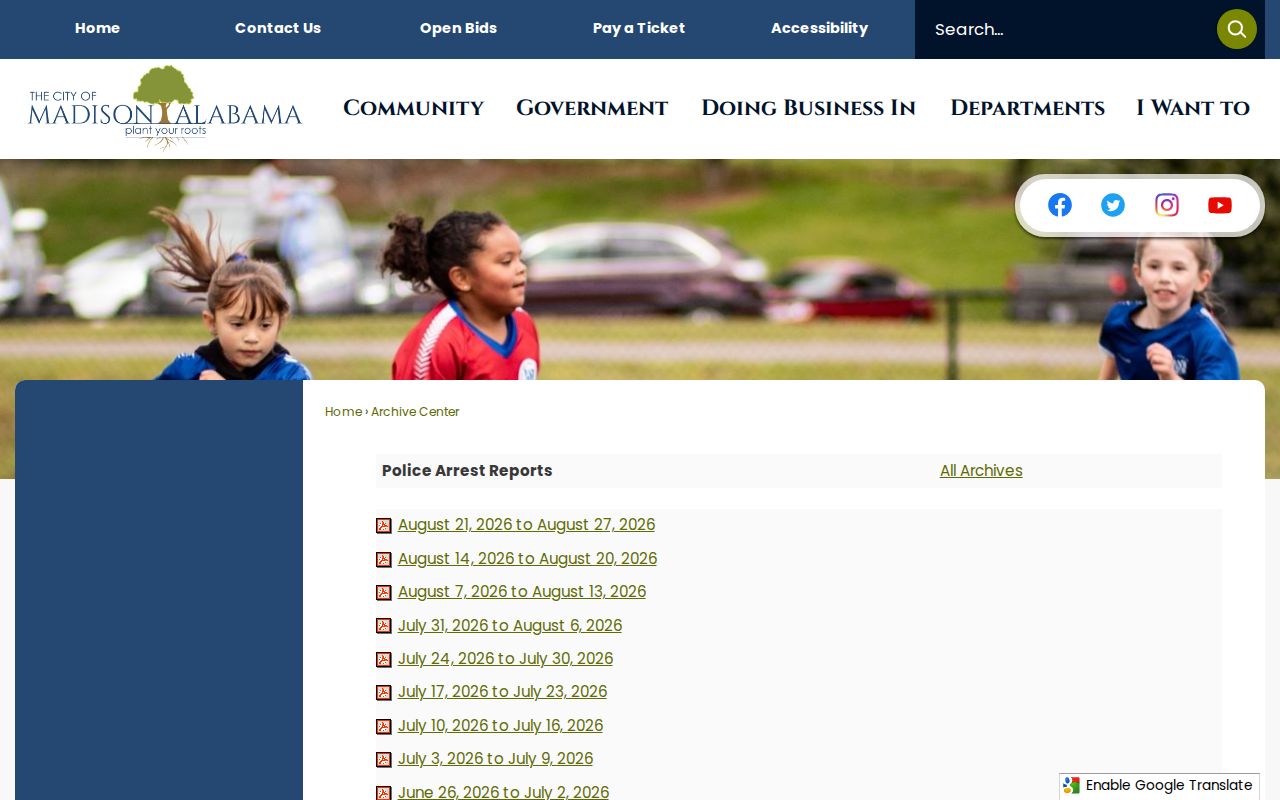
Treat the live archive as the controlling source. Date ranges there can shift, and an old legacy link is no promise that every weekly report between then and now remains posted.
Fields in a Madison Arrest Report
A city arrest report and a county custody roster answer different questions. Keeping the two straight keeps a weekly line item from being mistaken for a live inmate record.
| Report item | How to interpret it |
|---|---|
| Date and time | The event or report timing shown by Madison Police, not necessarily the later county-jail booking time. |
| Name | The person named in the arrest entry. Confirm identity with case and booking identifiers. |
| Location or address | The place attached to the city report, not proof of residence or detention location. |
| Case number | The best reference for Madison Police and a municipal case inquiry. It differs from an MCSO booking number. |
| Charge | The reported charge at that stage, not a conviction or final disposition. |
| Photograph | No booking photo was visible in the sampled weekly report. If county-booked, a current MCSO roster card may show one. |
| Custody status | Not established by the weekly report. Check MCSO or call 256-519-4800. |
| Court outcome | Not a complete report field. Obtain it from the municipal or county court handling the case. |
Weekend Arrests in Madison County
Neither the Sheriff's Office nor Madison Police commits to a weekend or holiday publishing schedule. The weekly report comes out periodically, so a late-Friday arrest or a holiday-weekend arrest may surface in a later date-range document. A county booking can also lag while transport, intake, classification, photography, and data processing run their course. Check both sources before assuming a delay means something was left out.
Madison’s Three-Month Web Policy
Madison Police prepares and updates its reports weekly and removes arrest records from the web automatically after three months. The stated aim is to guard against publishing youthful-offender and expunged records. That three-month clock applies only to the public web report. The underlying police file and court record stay intact, and unofficial publishers follow their own timetables. Read the official Police Reports policy:
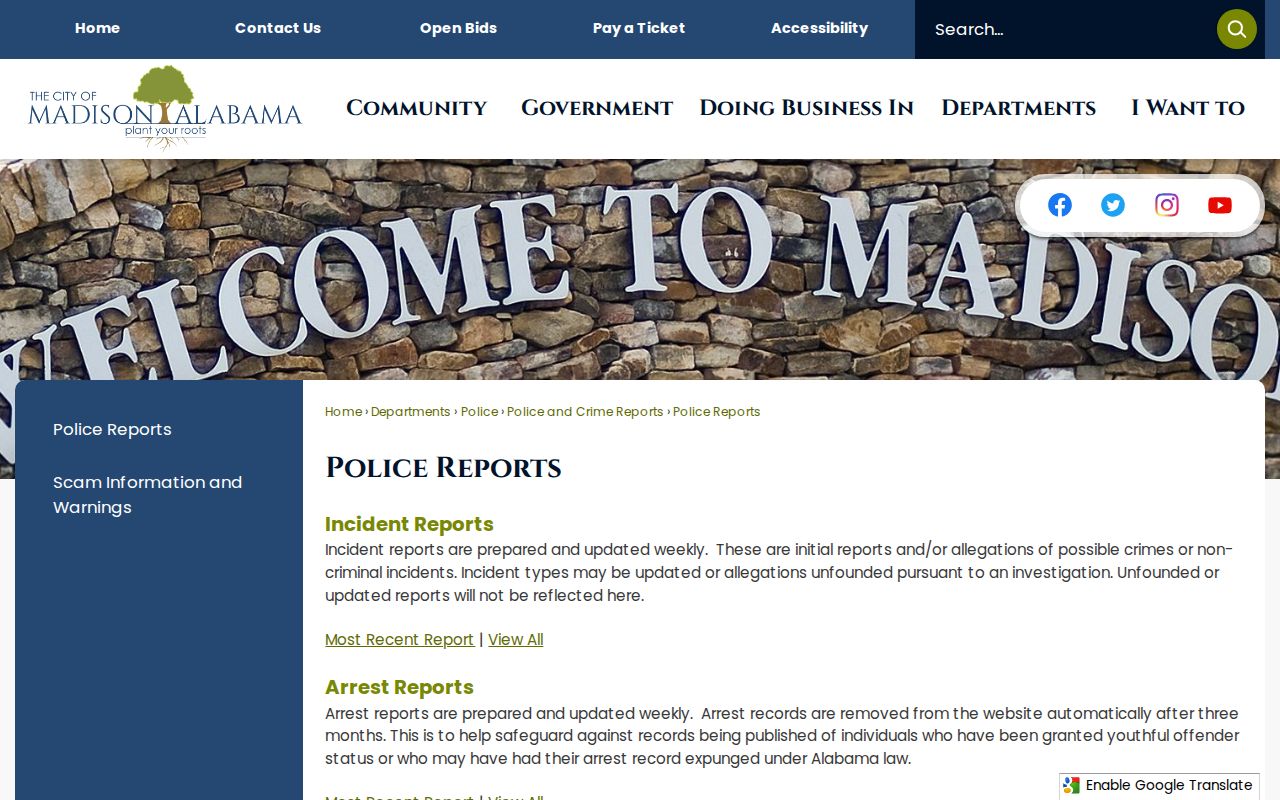
Use the policy to understand what stays online, then ask the record custodian about the underlying file. Automatic web removal is not an expungement, and it does not mean every other copy disappeared.
Older Madison County Arrest Records
The Sheriff's Office publishes no fixed retention period for roster cards or booking photographs, and its current-custody pages do not say how long a card lingers after release. For an older county booking, contact the Criminal Records Division at 705 Wheeler Avenue in Huntsville. Public hours run Monday through Friday, 8:00 a.m. to 4:00 p.m., and the local records service is listed at $10 with current state photo ID and cash payment. Give the person's name, the approximate date, the booking number, and the arresting agency, then request the booking sheet, jail log, photograph, charge or hold record, and any transfer or release information.
For anything older still, retention follows Records Disposition Authorities, which the Alabama Department of Archives and History explains set minimum retention and destruction rules for local records. Ask the Sheriff's Office or the city which RDA series covers the jail log, booking image, police report, or web export you want, whether it is still held, and whether a destruction notice exists. Assume nothing about a one-year or seven-year period. ADAH's historical incarceration collection centers on state corrections and its predecessors, so it is not a Madison County arrest archive.
Huntsville and Triana Log Gaps
Huntsville Police posts no standalone daily or multi-day arrest roster. The department runs a Records and Reports process and points inmate questions to the Sheriff's Office. To get a criminal-case report copy, HPD generally requires the requester to be the listed victim or reporting party with identification; anyone else may need a subpoena. The published report-copy path lists a $10 fee and asks for 72 hours. Triana has no online arrest blotter either. Written public-record requests go to the Town Clerk at 640 6th Street, Triana, Alabama 35756. That form asks for contact information, purpose, description, signature, and date, with no posted fee or turnaround. In either city, someone transferred to the Madison County Detention Facility may show up on the county roster. Where the arrest happened, where the person lives, which agency made the arrest, and where the booking occurred are four separate facts.
Local News Is Selective Coverage
Local TV and print outlets pick and choose which Madison County arrests become stories. WAFF 48 runs crime pieces plus a Huntsville-Madison section covering individual arrests, court dates, and wanted persons. WHNT News 19 and AL.com's Huntsville section report on area cases too, though neither posts a full county arrest gallery or a steady blotter. What you get is a photo sometimes, a surveillance image other times, or nothing at all. Coverage runs on newsroom judgment, so a story can land days after the booking or skip it entirely.
Treat the wording in these reports with care. Phrases like "police said" or "charged" attribute claims to an agency rather than settling them. A reporter can trace an operation or a court filing in depth, which a one-line log entry never could. Still, confirm details against the arresting agency and the court record before relying on them. Newsrooms do not promise that every Madison County arrest got ink.
From Madison Arrest to Disposition
A Madison arrest report documents a custody event and the charge filed at booking. Charges can shift afterward, reduced, dropped, refiled, or resolved without a conviction. A booking photo serves one purpose: identification. For a Madison city case, check whether it stays in municipal court. County matters run through district and circuit records kept by the Madison County clerk.
Custody can move a person between systems. Once an Alabama court imposes a sentence, the prisoner falls under ADOC tracking. Federal cases shift to BOP records, and immigration detention to ICE.